KodakAerochrome III 1443
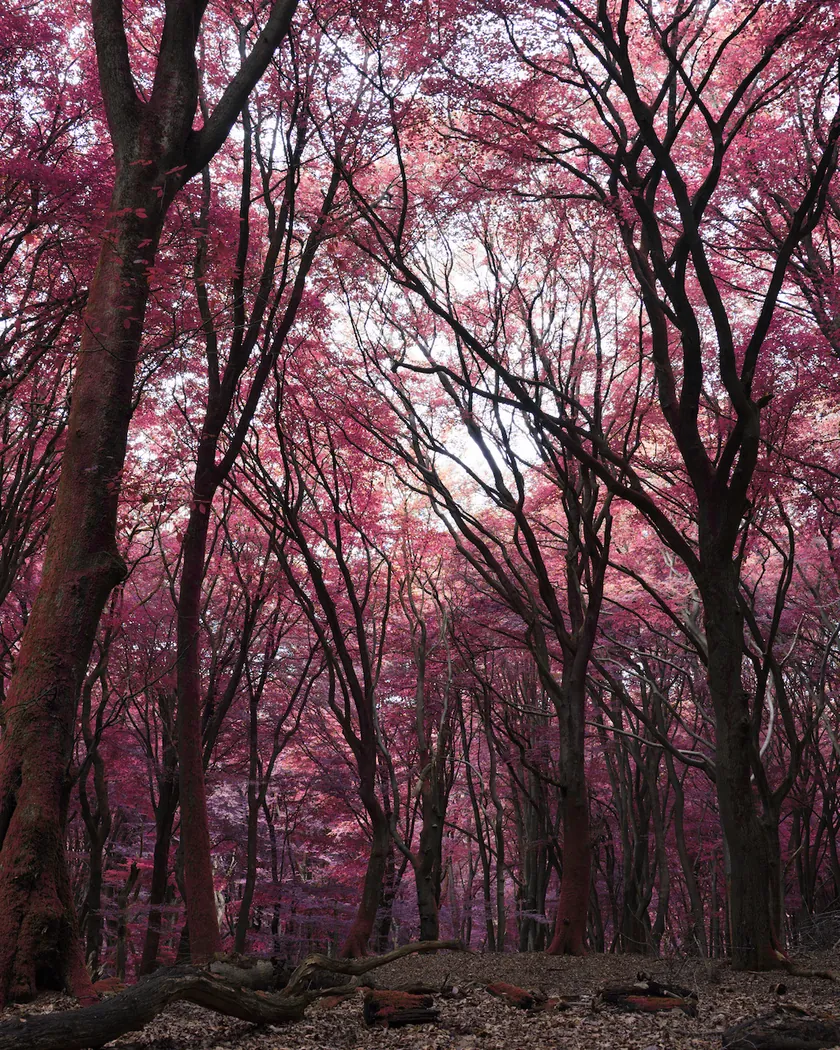
False color: healthy foliage magenta to red, sky deep blue to almost black, water very dark
- Manufacturer
- Eastman Kodak
- ISO
- 40 (aerial speed)
- Type
- Effects
- Process
- AR-5 (E-6 by labs)
- Formats
- 70 mm, 5 in, 9.5 in
- Status
- Discontinued (2009)
- Datasheet
- AS-77 (TI2562)
- Preset
- GA — 061 / P
Status checked [4]
Character
- Contrast
- Very steep characteristic curves (datasheet graph); reviewers report a narrow usable range
- Grain
- rms granularity 23 (datasheet); 'fine grain' per Kodak and Emulsive
- Latitude
- –½ to +2 stops (Emulsive); about three stops usable (Artistic Hive)
- Best for
- Landscapes with foliage, sky and water, shot through a yellow or stronger filter
Kodak Aerochrome III Infrared Film 1443 is an infrared-sensitive, false-color reversal film that Kodak made for aerial photography, where infrared differences can show things ordinary color film misses [1]. Healthy foliage comes out magenta or red, and sky and water go deep blue to almost black [1] [4]. It has been discontinued since about 2009 [3] [4].
Look and color
The datasheet gives the mechanism. The film has three layers sensitive to green, red and infrared, and all three also respond to blue, so a yellow Wratten 12 filter is “always used” over the lens [1]. Infrared prints as red, green as blue and red as green. Blue is blocked by the filter and prints black [1].
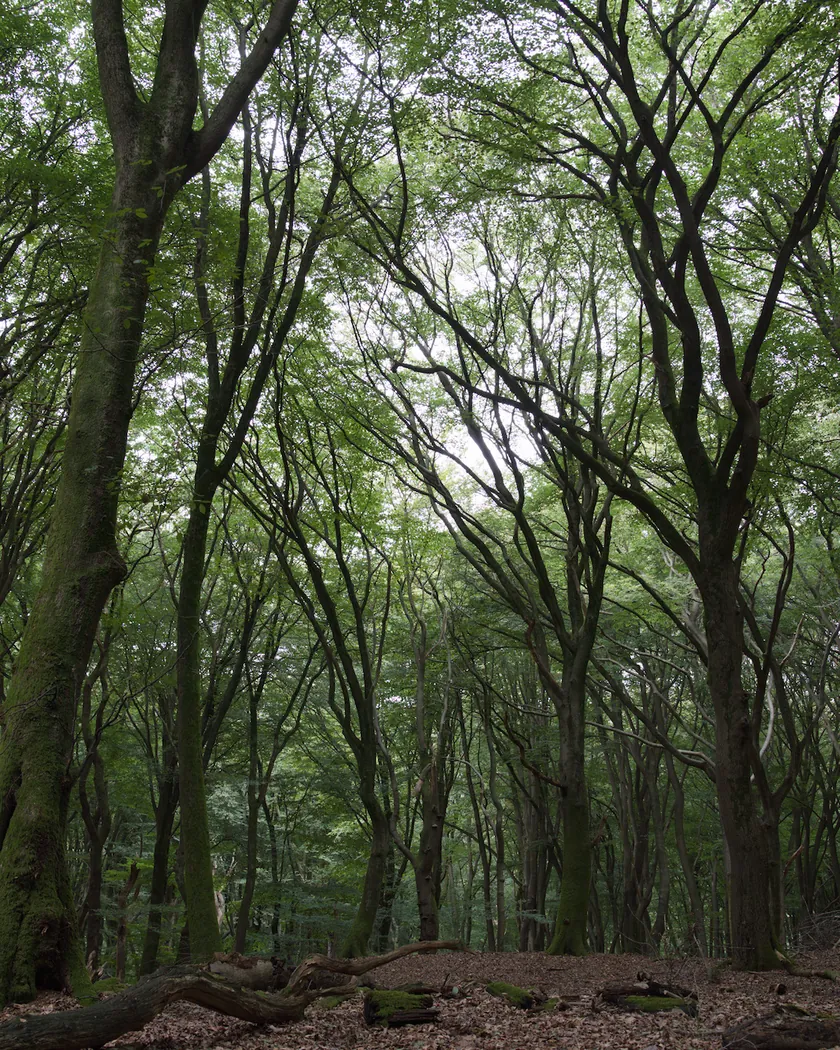
- Foliage. Kodak says healthy deciduous trees photograph magenta or red and healthy evergreens brownish red. Dead or dying leaves range from dark red to green or even yellow [1]. Reviewers describe “pink, purple, or deep red” foliage [2] and “magenta to scarlet” [4].
- Sky. Emulsive lists azure skies and black skies [2]. Artistic Hive says skies run from deep cobalt to nearly black, and that a redder filter increases the effect [4] [2].
- Water. Water reflects very little infrared and looks dark [1]. Reviewers call it black [2] or nearly black [4].
- Skin. The sources do not agree. Nick Orloff writes that it “doesn’t overly impact on skin tones” but “does turn lips green” [3]. That sits oddly with the datasheet rule that red prints green; Kodak does not describe skin.
- Saturation. Emulsive calls it “eye-popping” [2].
- The filter changes the look. Kodak specifies the Wratten 12. Emulsive says orange and deep red filters intensify the effect, at the price of riskier exposure [2]. Artistic Hive says that without the yellow filter blue floods all three layers and the color separation collapses [4].
- Storage matters. The infrared layer is the most affected by heat and age, which shifts the balance toward cyan [1].
Tonality
- Steep curves. The characteristic curves in the datasheet are very steep: density falls from about 3.3 to about 0.1 over about 1.5 log exposure, read from the graph. Kodak publishes no gamma value [1].
- Narrow latitude. Emulsive gives –½ to +2 stops [2]; Artistic Hive cites roughly three stops of usable range, and one source as low as half a stop [4]. Emulsive adds that shadows are lost fast in contrasty scenes and that overcast skies render as a white-out [2].
- Speed is not an ISO. Kodak rates it EAFS or ISO A 40 with a Wratten 12 and Process AR-5, and warns that aerial speeds should not be confused with pictorial film speeds [1]. Photographers using the respooled film report EI 400 [2] [5]. The two figures are not directly comparable.
- Reciprocity. Kodak says no adjustment is needed from 1/1000 s to 1/100 s [1].
Grain and sharpness
Kodak gives an rms granularity of 23, read at density 1.0 with a 48 µm aperture, and calls the grain fine [1]. We make no comparison with the granularity figures of negative films.
Resolving power is 63 lp/mm at a 1.6:1 test-object contrast and 100 lp/mm at 1000:1, described as medium [1]. Emulsive also calls the grain fine [2]. Artistic Hive describes “dye cloud grain” specific to this emulsion [4]. Emulsive reports that grain is more visible after C-41 development [2].
Spectral sensitivity
In the datasheet graph the green-sensitive layer drops out by about 610 nm and the red-sensitive layer by about 695 nm, while the infrared layer is much weaker but extends to about 900 nm [1]. That is why the film records infrared as red and why a yellow filter is needed.
Datasheet digest
| Item | Value | Source |
|---|---|---|
| Type | Infrared-sensitive, false-color reversal film, ESTAR base | [1] |
| Nominal speed, daylight | EAFS or ISO A 40, Wratten 12 filter, Process AR-5 (not comparable to a pictorial ISO) | [1] |
| Speed as a negative | ISO A 32 in AN-6 or C-41, so +1/3 stop of exposure | [1] |
| Spectral range | Ultraviolet, visible and infrared to about 900 nm | [1] |
| Required filter | Wratten 12 (yellow, minus blue) or equivalent, always over the lens | [1] |
| rms granularity | 23 (density 1.0, 48 µm aperture) | [1] |
| Resolving power | 63 lp/mm at 1.6:1 contrast, 100 lp/mm at 1000:1 | [1] |
| Reciprocity | No filter or exposure adjustment from 1/1000 s to 1/100 s | [1] |
| Typical exposure | About 1/300 s at f/5.6 with a Wratten 12, clear day, solar altitude 40°, aircraft at 10,000 ft | [1] |
| Base and thickness | 3.9 mil (0.10 mm) ESTAR base; 5.11 mil (0.129 mm) in total | [1] |
| Storage of unexposed film | Best at 0 to –10 °F (–18 to –23 °C); the IR layer is the most sensitive to heat | [1] |
Names, status and history
- Made for aerial use. The datasheet lists applications such as forest and crop surveys, archaeology, pollution monitoring, ice reconnaissance and camouflage detection [1].
- Discontinued. Nick Orloff gives the manufacturing span as ending in 2009 [3]; Artistic Hive says the film was discontinued in October 2009 [4]. Emulsive dates it around 2010 and says all stock expired by late 2011 [2]. We use 2009 and flag the disagreement. Artistic Hive separates it from Kodak Ektachrome Professional Infrared EIR, a different product that ended in 2007 [4].
- Formats. The datasheet’s processing tables list 70 mm, 5-inch and 9½-inch widths [1]. Artistic Hive says it was never sold as 120 rolls: every 120, 127, 4x5 and 16 mm Aerochrome that reached photographers was hand-cut and respooled from master rolls [4]. Emulsive names 35 mm, 120 and 4x5 [2].
- Processing. Kodak’s main process is AR-5 with EA-5 chemicals; AN-6 and C-41 produce a negative and cost about a third of a stop in speed [1]. Emulsive says E-6 or AR-5, and warns that lab machines with infrared sensors can fog the film [2].
- Availability today. Orloff quotes US$40 a roll in 2019 and A$485 to 575 on eBay in 2025 [3]. Artistic Hive expects over $300 for a roll of 120 in July 2026 [4].
- Names. The datasheet’s curve labels mention “SO-734” next to 1443; it does not explain the code, and we did not verify it.
- Successors. Emulsive named Lomography’s LomoChrome Purple as the closest current look [2]. It is a C-41 color negative with no infrared sensitivity. The Grain Archive style for this film is described on its style page [6].
Alternatives
- GA — 026 LomoChrome Purple
Emulsive calls it the closest film still made to the Aerochrome look; it is a C-41 color negative, not an infrared film
- GA — 039 LomoChrome Turquoise
Lomography's other color-shift C-41 film, also without infrared sensitivity
- GA — 017 Kodak Ektachrome E100
A current slide film for comparison: reversal E-6 like Aerochrome, but with true colors
Get the look in darktable
The GA — 061 / P preset, inspired by Kodak Aerochrome III 1443, is a darktable 5.6 style of 4 native modules, with no LUT. It sits on top of your own exposure and tone mapping.
| Zone | Metric | Before → after |
|---|---|---|
| sky | L (lightness) | 55.3 → 42.2 |
| sea | L (lightness) | 38.4 → 25.8 |
| skin | C (chroma) | 16.4 → 17.4 |
Settings, all measurements and limits of the Kodak Aerochrome III 1443 preset
GA — 061 / P · darktable preset
Aerochrome III 1443
for darktable
See real photos
Scans of real Kodak Aerochrome III 1443 film, published by others:
Questions about Kodak Aerochrome III 1443
Is Kodak Aerochrome still made?
No. Kodak Aerochrome III 1443 was discontinued around 2009; sources give 2009 or about 2010, and the last rolls expired in late 2011. Rolls sold today are old stock, hand respooled by resellers, at prices Artistic Hive put above $250 for a 35 mm cassette in July 2026. [2] [3] [4]
Why does Aerochrome turn plants red or pink?
Healthy leaves reflect a lot of near-infrared light. Kodak's film has a layer sensitive to infrared and prints it as red, so foliage comes out magenta or red, while green is rendered blue and red green. Water reflects little infrared and looks dark. Kodak says healthy deciduous trees photograph magenta or red and evergreens brownish red. [1]
What filter does Aerochrome need?
Kodak says a Wratten 12 yellow filter, or equivalent, is always used: all three layers respond to blue, and the filter keeps blue light off the film. Reviewers add that orange or deep red filters make the effect stronger, but exposure gets harder to judge as the filter gets redder. [1] [2]
What ISO should I use for Aerochrome?
Kodak rates it at aerial speed EAFS or ISO A 40 behind a Wratten 12, and says that figure should not be confused with an ordinary film speed. Photographers of the respooled film report shooting it at EI 400 with a yellow filter. [1] [2] [5]
Can darktable make an image look like Aerochrome?
Partly. A digital photo contains no infrared, so a style can only guess from color: it turns greens toward red-magenta and darkens blues. A green sign or plastic lawn turns red as well, which the real film would not do. The Grain Archive style for this film is an interpretation, measured on test images. [1] [6]
Sources
- 1DS Kodak, KODAK AEROCHROME III Infrared Film 1443, publication AS-77 (TI2562), revision 11-05 (archive copy) Accessed September 30, 2026.
- 2C Emulsive: Film stock review, Kodak AEROCHROME III color infrared film (EM, November 11, 2015) Accessed September 30, 2026.
- 3C 35mmc: Kodak Aerochrome and the economics of shooting this unusual film stock (Nick Orloff, July 31, 2025) Accessed September 30, 2026.
- 4C Artistic Hive: Kodak Aerochrome (Matteo Martignago, availability and prices checked July 27, 2026) Accessed September 30, 2026.
- 5C Emulsive: 5 Frames of the Saskatchewan prairies on Kodak Aerochrome III 1443, 120, EI 400 (Bob St. Cyr, December 21, 2020) Accessed September 30, 2026.
- 6B Grain Archive: Kodak Aerochrome III 1443 style, measurements
DS: datasheet · C: review or community · B: Grain Archive measurement